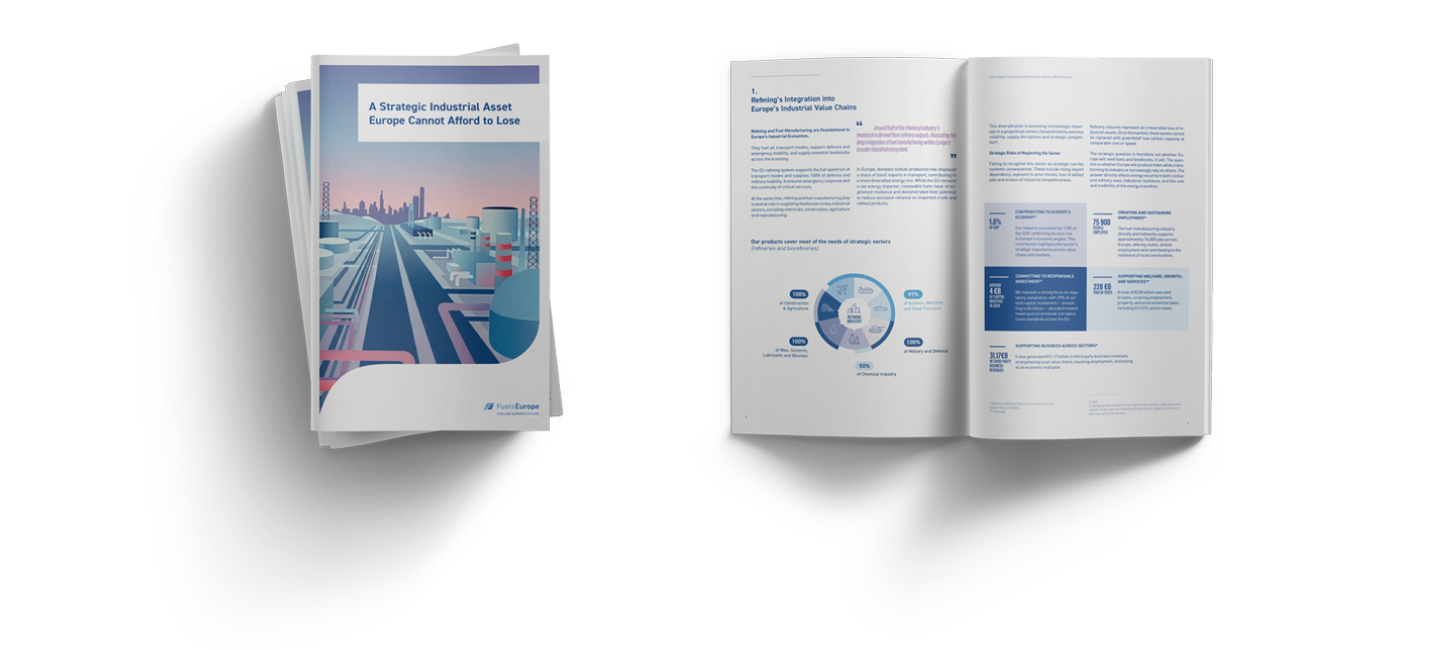
Europe’s fuel manufacturing and refining industry is a strategic industrial asset that underpins energy security, industrial competitiveness, defence readiness and the resilience of key value chains. The sector supplies essential fuels for aviation, maritime transport and other hard-to-electrify sectors, while also providing critical feedstocks for chemicals, construction, agriculture and manufacturing. Yet rising energy costs, regulatory complexity, carbon pricing and investment uncertainty are eroding competitiveness and increasing the risk of permanent refinery closures. Once lost, these assets are difficult and costly to replace.
Europe therefore faces a strategic choice: maintain and transform its domestic refining capacity, or become increasingly dependent on imports. The most effective pathway is to convert existing refineries into low-carbon and renewable fuel hubs, building on established infrastructure, industrial expertise and strategic capabilities. This requires stable policies, investment certainty and a pragmatic regulatory framework that supports industrial transformation while safeguarding competitiveness
FuelsEurope’s strategic priorities
Leverage the strategic role of refining
FuelsEurope aims to strengthen recognition of refining and fuel manufacturing as a strategic industrial capability for Europe. This includes:
- Pursuing a Strategic Dialogue with the European Commission that leads to an Action Plan for the sector.
- Building alliances across industrial sectors and strengthening cooperation with stakeholders.
- Demonstrating the industry's essential role in defence readiness and military preparedness.
Ensure competitiveness of refining
The transition can only succeed if Europe maintains a competitive industrial base. Priorities include:
- Securing a fair and investment-friendly revision of the EU ETS framework.
- Addressing the unintended consequences of the Methane Regulation and ensuring pragmatic implementation.
- Supporting the European Commission’s simplification agenda to reduce regulatory burdens and strengthen industrial competitiveness.
Enable investment cases for the low-carbon transition
Europe needs regulatory frameworks that unlock investment in renewable and low-carbon fuels. FuelsEurope is therefore focused on:
- Recognition of renewable and carbon-neutral fuels in CO₂ vehicle standards.
- Ensuring renewable fuels contribute to the decarbonisation of corporate fleets.
- Delivering a stable and predictable post-RED III framework that supports long-term investment and harmonised implementation across Member States.
Europe's energy transition and industrial competitiveness must advance together. The refining and fuel manufacturing industry is not a legacy sector. It is a strategic capability that supports energy security, industrial resilience, defence preparedness and climate ambition. Preserving and transforming this industrial base should therefore be a core element of Europe’s competitiveness and strategic autonomy agenda.